In the crypto space, we see two, simultaneously paradoxical and complementary, trends. The first trend is the rise of wallets as an identity. Wallets are now someone’s credit score, reputation, resume, and more. With NFTs, they’ve also become someone’s physical appearance. At the same time, anonymous devs and employees are becoming more common. With DAOs becoming a powerful force in the space, talented people can now just pick up DAO bounties and get paid completely on-chain without ever revealing their fleshy, meatspace self.
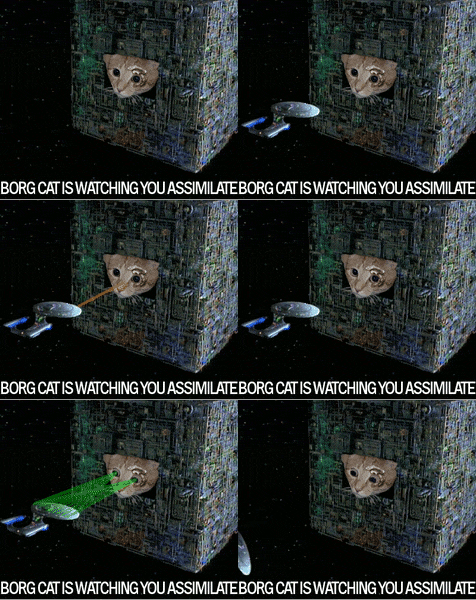
However, there is no reason that a wallet necessarily has to represent a single person. In Star Trek, there’s a group of aliens called Borgs. Borgs are characterized as being part of a hivemind, in which individuals all merge into one collective intelligence. Instead of having names, they refer to each other as parts of a larger group (seven of nine, three of five, etc.) The anonymity of crypto, alongside the identification systems that total transparency offers, allows anyone to become their own Borg collective.
In fact, perhaps this is the first step of transhumanism. Perhaps humans first transcend our bodily prisons not in the physical world, but in the digital. Not only are people not required to confine themselves to a single human identity, they are in fact incentivized to merge their skills and intelligence with others. While it’s rare for someone to be a great designer, programmer, and salesman all at once (unless ur anish), it’s not nearly as difficult to find two people that have the skills you lack, and work with them. DAOs can easily hire the group (and check the validity of their skills through on-chain identity) and the collective individual is rewarded for curating a strong team.
There are definitely interesting second-order effects of this happening. For example, someone could be part of more than one collective individual simultaneously, allowing them to inhabit multiple bodies at once. They would also potentially have different reputations, both empirically on-chain, and socially. With all interactions being digital, many of today’s prejudices go away, but are replaced by new ones (hee hee ur NFT avatar is cheap im not gonna talk to u). The nature of a company’s (or in this case a DAO’s) interactions with an individual also change when people shift to being collective individuals. For example, what if one member of the DAO has a falling out with a member of a collective individual? What are the repercussions of that? Is this even possible with anonymity? This is probably like DeFi, we can try to predict the effects all we want, but the super cool stuff won’t be known until it actually happens.
Furthermore, while thinking about collective individualism in the context of work is interesting, it doesn’t stop there. With more and more activities happening online and if the metaverse (idk if i can say this word anymore without sounding like one of those vcs that were all like iBm suPplY liNE bloOckhchiain!!) takes off, our physical selves lose more and more importance. In a few decades, collective individualism could be the main way that people interact. The digital world, our main world, could be populated by millions of eclectic NFT avatars, who are controlled by the billions of humans hidden underneath. We could see entirely different communication methods, laws, and social etiquette. What does collective individual ownership look like? What does a chat room for collective individuals look like? What happens when two (or more? UwU) collective individuals fall in love?
If this is interesting, you should read: https://otherinter.net/research/squad-wealth/